Humanitarian OpenStreetMap Team

Recent Updates

Posted by kate on Mar, 19 2012
Yesterday the World Bank further committed to open-data on their blog by stating "the World Bank only supports citizen-mapping efforts that give users free access to the map data they create." This commitment to open-data will ensure that those putting data in are able to also utilize this information. Such an announcement brings much relief to myself and many others concerned after a previous announcement about an agreement between the World Bank and Google.
Posted by kate on Mar, 12 2012
Last week I attended a meeting to discuss expanding the community mapping projects using OSM eastern Indonesia, as well as ensuring they are sustainable.  Attendees included myself as well as representatives from AIFDR, ACCESS, SOLUD, Mitra Turatea and GIZ. HOT did our first workshop with community facilitators from ACCESS in March of 2011. Much has changed since the initial workshop, which was just a traditional OpenStreetMap training session over two days.
Posted by sev_hotosm on Mar, 10 2012
The week I arrived in Saint-Marc occurred the Night Of the Living Maps (NOTLM), a worldwide event within the OSM community, “where all mappers come together in local meetings and trace imagery the whole night long, while the moon shines bright!”. Groups form large and capital cities like Bogotá, Copenhagen, Madrid, Paris - Rome, Vienna, St. Petersburg orTokyo - were participating but also smaller ones like Esslingen, Mankato, MN , Passau or Rapperswil. Anyway, it was an excellent opportunity for the freshly trained young mappers of Saint-Marc to both figure out the power of the OSM community and show their own enthusiasm to the open source geodata.
Posted by kate on Feb, 29 2012
Rapid growth and low elevation makes flooding in Jakarta problematic. Innovative approaches are needed for contingency planning and impact modeling.  DKI Jakarta's Disaster Management Agency (BPBD) is developing a detailed scenario to estimate impacts of future flooding. This scenario will estimate the impact on people, schools, hospitals, and other important buildings. Such a scenario will become a powerful tool for local government and other stakeholders to take action to be better prepared for future floods. This first step in this type of analysis is having available data, without data it is impossible to make an accurate estimation. Throughout March mapping events will be held in DKI Jakarta to work with local leaders to collect such data, by utilizing OpenStreetMap.
Posted by pierre.beland on Feb, 22 2012
Foreign Affairs and International Trade Canada department (DFAIT) Open Policy Day Session, Feb. 9 in Ottawa, was attended by 200 staff members. Personal in embassies could follow the morning session by teleconference. The objective was to expose the DFAIT staff to new ways of working for policy making and information exchanges inside the department (ie. Web 2.0, Social network, Open Data, Open Innovation, NGO's and how to adapt with collaborative efforts, etc). There were formal presentations in the morning from USA Secretary of State staff and DFAIT staff, Google, Wikimedia Foundation and World Bank representatives.
Posted by sev_hotosm on Feb, 20 2012
After the three weeks set up made by Nico and Brian, it is my turn to come on and support the project on the ground after having done it remotely through the writing of the JOSM presets and other technical and guidelines documents, after of course, months passed to set the project from scratch and made it accepted by the funder. It is my seventh time in Haiti since the 01/12/2010 earthquake, a country I started to learn after having worked with Haitian colleagues on the GIS field in 2008. I really entered into the OSM world by mapping Port-au-Prince during the next weeks after the quake and joined the Humanitarian relief in February to help the emergency action.
Posted by kate on Feb, 6 2012
Below is a video about OpenStreetMap in Afghanistan, HOT member Hameed has been mapping and teaching others to map there over the past two years. As you can see the Jalalabad City map is quite detailed. Pretty impressive for a place where a reliable fast Internet connection would cost $1000 a month.
Posted by brian on Feb, 1 2012
Hey there, Hi there, Ho there, Checking in from beautiful coastal Saint Marc. Everything has been proceeding along here at a terrific pace. Now that the team of young people to be trained is organized and ready to go the COSMHA team has been busy training and coordinating all these people. Most days start at 7:30 with a COSMHA team meeting. At 8 the youth come and there is a morning lecture. During this time the team finishes up the preparation of any materials for the days activities and maybe participates in a training them selves.
Posted by mikel on Jan, 31 2012
On January 14, we formally closed HOT's activation to help map health facilities in Libya. This was definitely a new kind of activity for HOT. To start, we were directly by WHO to take part, and staff at the Tunis WMC office was incredibly active in the entire process.
Posted by kate on Jan, 30 2012
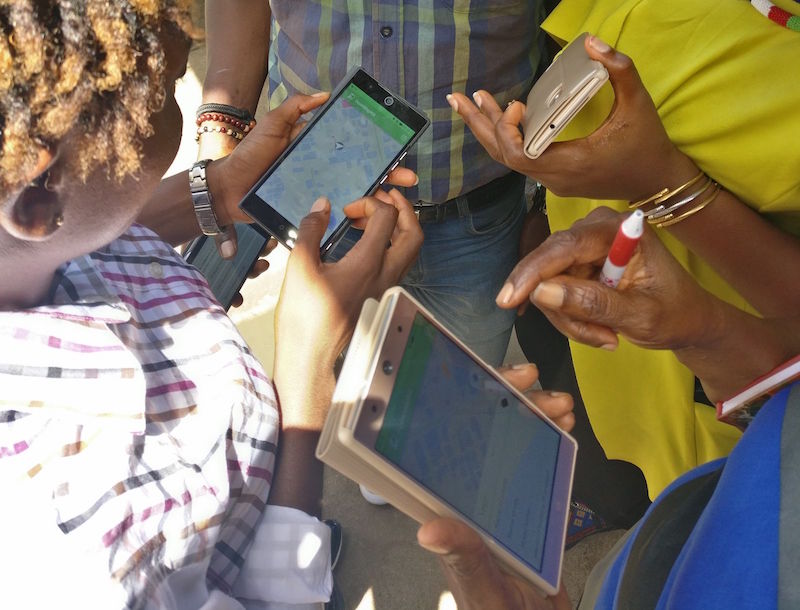
This week Vasanthi, Emir and I returned to Bima and Dompu. It is always interesting when you leave someone with technology alone and then come back and see what they have done. Questions often have often built up, but usually some solutions as well. People don’t wait for your to return to move forward, they usually either abandon what they have been taught or adapt to their own situations and uses. Bima and Dompu were no different.